Monday, August 16, 2010

Climate Change Activists: For or Against Nuclear?

On one hand, if you look at France, nuclear has a track record of being inexpensive, safe, environmentally sound (in the sense that much less radiation is released into the environment by a nuclear power plant than a coal power plant), and has an overall low CO2 footprint. I'm going to state sources below for each one of these statements as a matter of course, even though my impression is that most of my readers are well aware of these characteristics of a nuclear power.

On the other hand, this great track record hinges on having a very high level of trust in the quality of the regulation apparatus. In a country like France, where the political system is somewhat healthy, and on the whole accountable to the people, it is easier to support nuclear. In the country that gave birth to the Deepwater Horizon disaster, it's harder. Furthermore, this judgment call on the quality of the political system has to be made for now, and for far into the future. For some people, no political system can uphold such a demanding long-term guarantee of stability. Again, I'm confident that everyone here is well aware of this dynamic.

Thus, whether one supports for opposes nuclear energy depends on a careful weighting of of three somewhat subjective impressions: How much do you trust your politicians?, versus how dire is the climate situation?, versus what alternatives are there? If you would like to see the difficulty of resolving these three questions play out in a large conference room, amongst a crowd of smart, well-informed people of all specialties, I'll recommend the following TED Talk:


TED Talk Debate: Does the world need nuclear energy?


In short, a well-informed environmentalist can come to either conclusion, for or against nuclear power; that's what's happening in our group. I don't think it is possible to resolve this diversity of opinions. I doubt the world can come to a consensus, no matter how much time we spend.

Thankfully, I do not see the need to come to a consensus. Not now at least. There is plenty of solutions to global warming calling for our considerations before the questions of nuclear energy becomes unavoidable. I would humbly suggest we focus everyone's efforts on these other solutions.


Inexpensive:


Projected costs of generating electricity: 2005 update By OECD Nuclear Energy Agency

Their investigation of the cost of numerous power plants identified the following cost brackets for different technologies.

Nuclear: 21 to 31 $USD/MWh
Coal: 25 to 50 $USD/MWh
Gas: 35 to 50 $USD/MWh
Wind: 35 to 95 $USD/MWh
Micro-hydro: 40 to 80 $USD/MWh
Solar: 150 to 300 $USD/MWh


Safe:


Deaths per TWh for all energy sources: Rooftop solar power is actually more dangerous than Chernobyl. (Construction workers fall off the roofs all the time)

Environmentally sound:

Coal Ash Is More Radioactive than Nuclear Waste. By burning away all the pesky carbon and other impurities, coal power plants produce heaps of radiation.

Low CO2 footprint

Carbon emissions from electricity generation: a life-cycle analysis.

Table 1. Total lifetime releases of CO2 from electricity generating technologies

Coal Gas Solar PV Nuclear Wind Hydro

kg CO2/MWeh
ExternE [1] 815 362 53 20 7 -
UK SDC [2] 891 356 - 16 - -
U. of Wisconsin [3] 974 469 39 15 14 -
CRIEPI, Japan [4] 990 653(a) 59 21 37 18
Paul Scherrer Inst. [5] 949(b) 485 79 8 14 3
UK Energy Review [6] 755 385 - 11–22 11–37 -
IAEA [7] 968(c) 440(c) 100(c) 9–21 9–36 4–23
Vattenfall AB [8] 980 450 50 6 6 3
British Energy [9] 900 400 - 5 - -

Wednesday, May 5, 2010

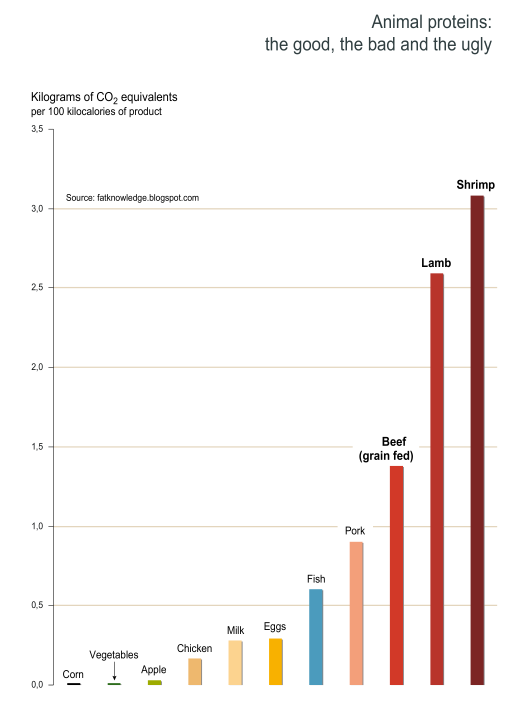
This is why I eat chicken

Here is why I eat some chicken, no beef, I why I won't be eating shrimp anymore.

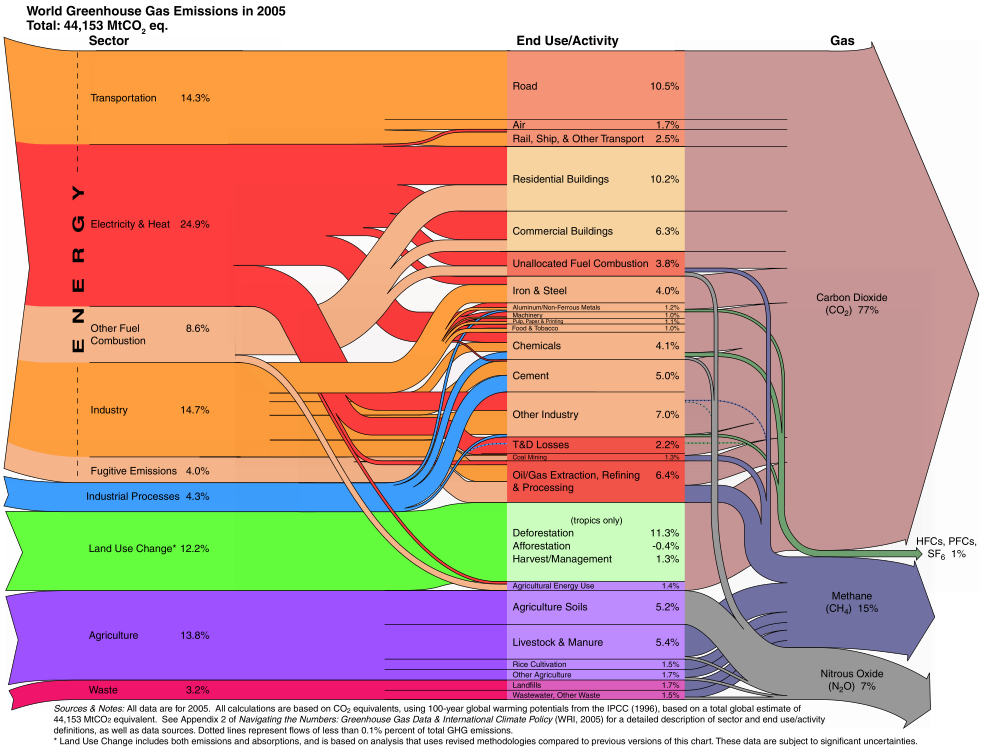
This chart is taken from the fantastic report by the UN, "Kick the Habit, a UN Guide to Climate Neutrality.", page 103. You need to combine it with the World Ressource Institute chart, pasted below, on the proportion of the entire problem that is caused by different activities, including agriculture and livestocks (it's 12.3%.)

It's also the reason I drive a 70 mpg motorcycle, and why I lobby for 100% clean electricity for Massachusetts by 2020.


Tuesday, May 4, 2010

Apple is the new dictator of my industry

I am distressed at the number of the IT professionals who are taking Apple's claims about the goal of the App Store's no-Flash or other such programming languages policy at face values. Apple's objective when refusing Flash has nothing to do with their stated position. Their concerns over quality or stability are not credible, when their action indicate that their goal with disallowing Flash is to reinforce their lock down on the platform. Indeed, Apple has already begun abusing the new-found benevolent dictator position:

Apple's PR department has been spinning their intent since the very moment of the release of the iPhone.

In the late '90s, Microsoft tried to use its monopoly position to crush the possibility that web application could become sufficiently feature-rich to compete with Windows. After years of fighting against that abuse of monopoly power, mainly through the funding of a huge effort to create the Firefox browser, today we enjoy thousands of rich and innovative web applications.

On the back of that success, we geeks are now handing a control of our computing to Apple. If one person buys an Apple products, no harm is done; if we all do, we instantiate an abusive monopoly, one that promises to be even more severely clutched than Microsoft's was.

I humbly suggest you considers boycotting Apple's products, and donating to an organization which fights monopoly abuse, such as the Electronic Frontier Foundation or the Free Software Foundation.


Saturday, May 1, 2010

Climatologist sues, wants paper to widthdraw its libelous statements

Via Andrew Trumper:

It's probably an unfortunate measure of the quality of modern journalism that few of us would be surprised to hear that an editorial on a politically controversial topic contained significant factual inaccuracies.

But climate change seems to have reached the point where even some apparent facts have become points of contention, and at least some reporters have become comfortable with simply making things up and ascribing their imaginings to credible scientific sources.

Apparently fed up with similar practices in editorials produced by Canada's National Post, a climatologist has now sued the publisher for libel and defamation. But the suit seeks a judgment that's remarkably sweeping: the scientist wants the publisher to hand over the copyright to the editorials so he can attempt to erase them from the Internet.

Link to the Ars Technica article on the matter.

Friday, April 23, 2010

Facebook has gone rogue

You can tell Facebook has gone rogue. After they began leaking information that their user had marked "private," they have now elected to leak this information to any websites you visit.

They require everyone to go through contortions to opt-out, and when you finally reach the button, it is labeled:
Allowing instant personalization will give you a richer experience as you browse the web. If you opt-out, you will have to manually activate these experiences.
You can tell from the turn of sentence that Facebook has been handed over to the marketing department, and that these individuals do not have your best interest at heart. Bastards.

After you uncheck the box, Facebook will reach for an excuse to continue leaking your information, and interpret your friends' non-opting-out as a permission to leak your information on their behalf. Facebook's message continues:
Please keep in mind that if you opt out, your friends may still share public Facebook information about you to personalize their experience on these partner sites unless you block the application.
In order to maintain you sense of inconspicuousness, you have to turn off acquaintance leaking as well.

Thursday, April 8, 2010

Catastrophic Rapid Climate Change

According to Krugman's excellent summary of the consensus amongst economists is that avoiding catastrophic rapid climate change would cost 0.03 to 0.09 percent point of growth per year until 2050. In other words, the annual to 2050 would be 2.31 percent, instead of 2.4 percent. That is very small indeed. Put another way, it would cost 775$ per household over 40 years, which is about 20$/year. And at 2.66 persons per household on average, solving the problem cost a whole 7.26$/year. It's about the price of the Starbucks latte you took Jan 17st, plus the price of the one from Aug 23rd.

Let's do a cost/benefit analysis. If we maintain the status-quo, and proceed as usual and burn all the coal available on this planet, the temperature goes up by 11F (see the question-and-answer section at the end of the talk.) New York becomes Mississippi and Mississippi becomes unlivable. If we burn all the coal, we return to the temperature on the planet before the coal was made, 55 millions year ago. It was the time of the Paleocene-Eocene Thermal Maximum, a "slow" event, with a gradual warming spread over 20'000 years time, that nevertheless resulted in a mass extinction.

Meanwhile, we human have sufficient coal-fire power plants deployed to get that kind of change done in 100 years. Go us!

So, to complete this cost/benefit analysis, I ask you, how much is your planet worth?

Monday, March 1, 2010

Americans have more investements in each other's health care than Canadians

Little known fact: Health care in America is funded by the government to a greater extends than in Canada. Between Medicaid, Medicare, Military Health Care, and emergency room services for the non-insured or the under-insured, the American government pays US$2,728 per person per year for health care. That's 23% more than the Canadian government expense (US$ 1,893.)

Ref: Wikipedia on the difference between the US and Canadian health care systems.